Somalia faces one of the highest rates of Female Genital Mutilation (FGM) globally. This pervasive custom is often upheld by influential community figures, such as Traditional Birth Attendants (TBAs), who view it as both a cultural duty and a critical source of income. To address this complex issue, the Humanitarian Umbrella for Relief and Development Organization (HURDO), in partnership with action medeor and with funding from Bundesministerium für wirtschaftliche Zusammenarbeit und Entwicklung (BMZ), is implementing a “Stronger together” project in Hodan District. This initiative included a component of an intensive, localized training targeting these key practitioners. The goal is to replace traditional cutting practices with life-saving maternal health knowledge and transform cutters into powerful local advocates for change.
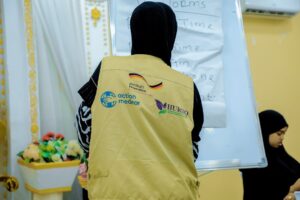
A facilitator writes on a flip chart during the TBAs training
For decades, Amina Farah, a 55-year-old Traditional Birth Attendant (TBA) in Mogadishu’s Hodan District, held a position of profound trust. She was the woman families relied on for safe deliveries and, critically, for performing FGM.
Amina explains her situation simply: “It was what my grandmother taught me. If a girl is not cut, she cannot marry. It was a matter of honor, and it was also how I earned money to feed my family.”
Despite witnessing the painful and tragic health consequences such as severe bleeding, chronic infections, and life-threatening childbirth complications, the overwhelming cultural and economic pressures kept the cutting tools in her hands, trapping her in a cycle of harm.
Amina’s journey of transformation began when she was selected for the intensive HURDO training. The training was designed to be revolutionary, utilizing clear, visual, step-by-step illustrations to connect the cutting process directly to the resulting long-term health outcome.
The medical facts replaced superstition with biological truth. “I saw the drawings showing the inside of the body. They explained that when I cut a girl, I was putting a lock on her future,” Amina recounts.
Significantly, the training didn’t just provide medical knowledge; it equipped her with the social tools needed for her new role, teaching her how to use her respected TBA status to counsel mothers and promote safe, uncut births while still protecting family honor.
Empowered by this new knowledge, Amina took a decisive and deeply symbolic public step, by putting her cutting tools away forever. Her new mission became Protection, beginning immediately with her own family, ensuring her three young granddaughters would be the first generation in her lineage to be spared from FGM. Amina has since become a dedicated Direct Advocate against the practice. Using her unique credibility as a former practitioner, she tirelessly counsels’ mothers before they decide to cut their daughters. Since completing the training, Amina has facilitated over 20 confidential discussions with community members across Hodan. Her commitment has yielded tangible life-changing results. She has confirmed that eight girls who were scheduled for the procedure were saved, thanks to her direct intervention and persistent follow-up.
Amina continues to serve her community as a Traditional Birth Attendant, but her hands now only bring safe delivery and healing. She has successfully transitioned from being a custodian of harm to a powerful protector. Her personal journey from despair to hope reflects the success of the HURDO program, which stands as a powerful model for ending FGM across Somalia by empowering those closest to the tradition.
“The training did not take away my job, it gave me a better one. Now, my work is about giving life and ensuring that girls grow up safe, whole, and free from FGM. This is the new honor,” Amina said






0 Comments